
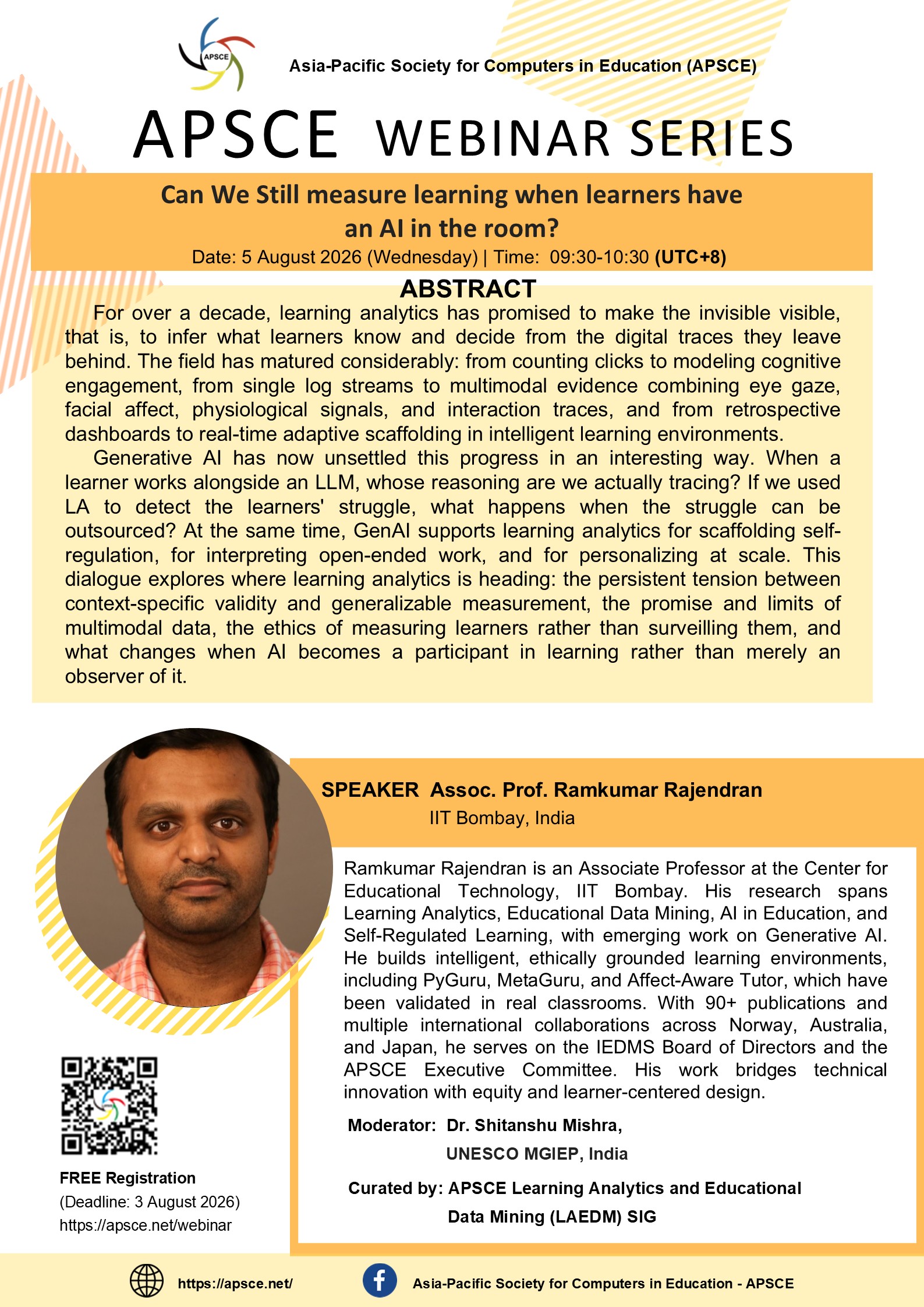
Speakers: Assoc. Prof. Ramkumar Rajendran (IIT Bombay, India)
Moderator: Dr. Shitanshu Mishra (UNESCO MGIEP, India)
Curated by: APSCE Learning Analytics and Educational Data Mining (LAEDM) SIG
Date: 5 August 2026 (Wednesday)
Time: 09:30-10:30 (UTC+8)
Register before 3 August 2026:
https://us06web.zoom.us/webinar/register/WN_6Kbr_dUuTc6A10PVyLex3g
Abstract:
For over a decade, learning analytics has promised to make the invisible visible, that is, to infer what learners know and decide from the digital traces they leave behind. The field has matured considerably: from counting clicks to modeling cognitive engagement, from single log streams to multimodal evidence combining eye gaze, facial affect, physiological signals, and interaction traces, and from retrospective dashboards to real-time adaptive scaffolding in intelligent learning environments.
Generative AI has now unsettled this progress in an interesting way. When a learner works alongside an LLM, whose reasoning are we actually tracing? If we used LA to detect the learners' struggle, what happens when the struggle can be outsourced? At the same time, GenAI supports learning analytics for scaffolding self-regulation, for interpreting open-ended work, and for personalizing at scale. This dialogue explores where learning analytics is heading: the persistent tension between context-specific validity and generalizable measurement, the promise and limits of multimodal data, the ethics of measuring learners rather than surveilling them, and what changes when AI becomes a participant in learning rather than merely an observer of it.
Biodata:
Ramkumar Rajendran is an Associate Professor at the Center for Educational Technology, IIT Bombay. His research spans Learning Analytics, Educational Data Mining, AI in Education, and Self-Regulated Learning, with emerging work on Generative AI. He builds intelligent, ethically grounded learning environments, including PyGuru, MetaGuru, and Affect-Aware Tutor, which have been validated in real classrooms. With 90+ publications and multiple international collaborations across Norway, Australia, and Japan, he serves on the IEDMS Board of Directors and the APSCE Executive Committee. His work bridges technical innovation with equity and learner-centered design.